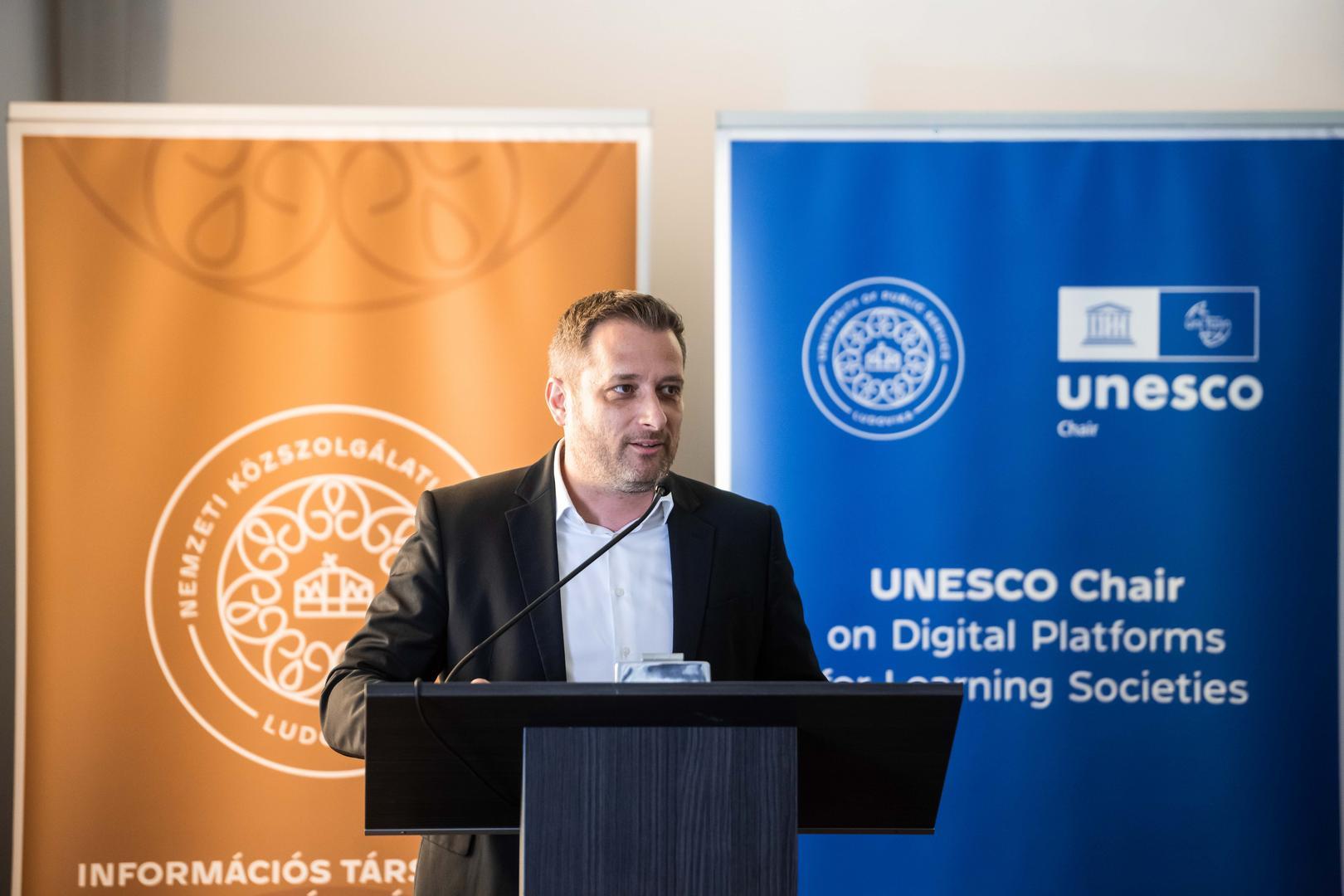
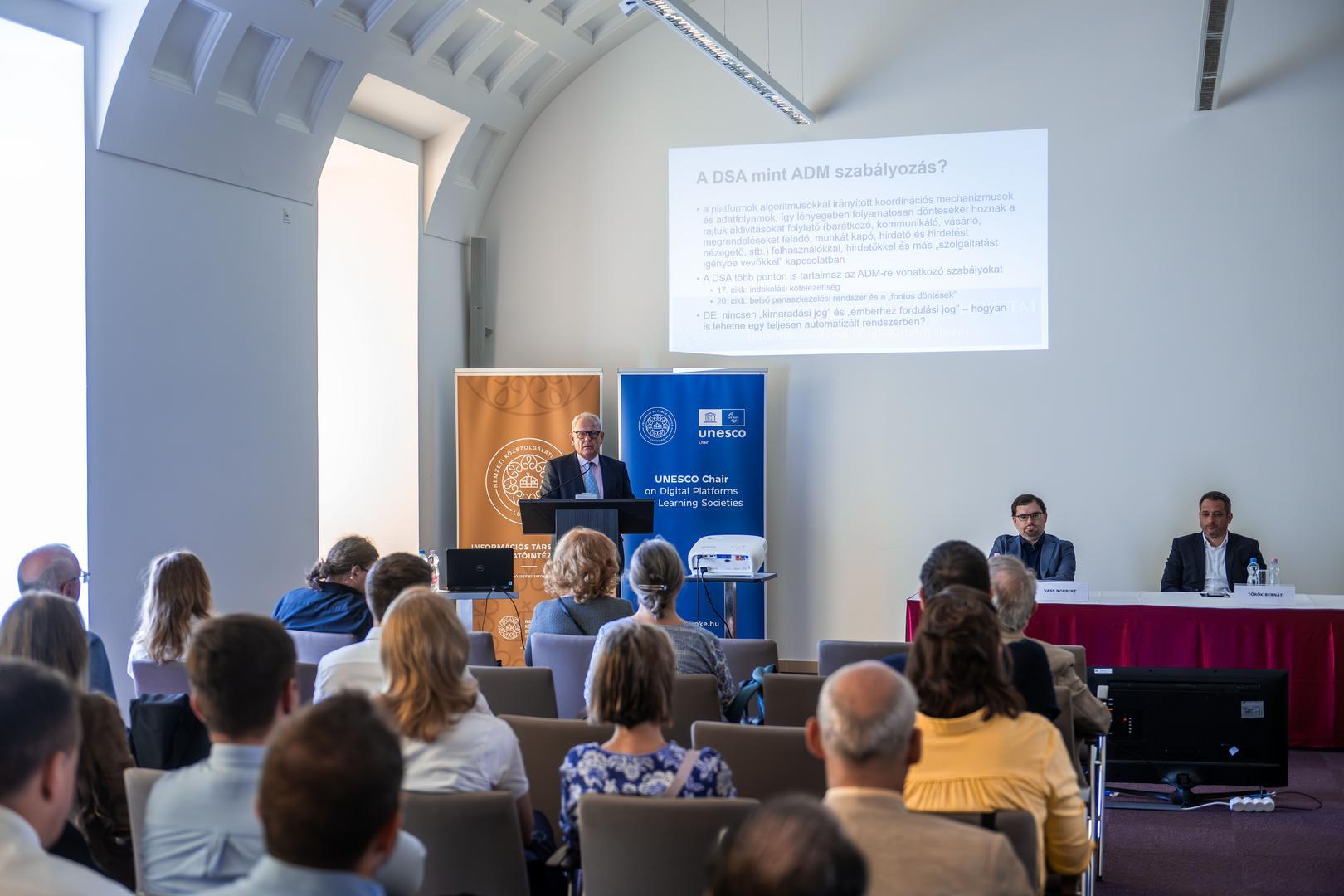





The Institute of the Information Society (IIS), UNESCO Chair on Digital Platforms for Learning Societies at the Ludovika University of Public Service — in cooperation with the National Authority for Data Protection and Freedom of Information — held its annual conference on May 27, 2026, titled Social and Regulatory Futures in the Age of Emerging Technologies.
Continuing the tradition of recent years, the conference focused on the transformative impact of the latest digital technologies and examined what social and regulatory visions lie ahead, taking into account the developments of recent years and the challenges of today.
In his opening remarks, Bernát Török, head of the IIS UNESCO Chair on Digital Platforms for Learning Societies, noted that the institute’s annual conference is both a tradition and a source of constant renewal. It is the diversity of the speakers that truly brings the event to life and makes it inspiring. As he put it, as organizers, they work not out of routine, but out of commitment and professional curiosity to ensure that the conference is relevant from both practical and theoretical perspectives.
Bernát Török added that what makes this year’s event special is that IIS was able to organize the conference as a UNESCO Chair, which is also closely linked to the global organization’s Future Dialogues initiative. He emphasized that, amid the rapid technological transformations of our time, it is particularly important not to think solely in terms of apocalyptic visions of the future. Although changes can carry risks, the future is not predetermined: shaping it is our shared responsibility at the individual, societal, European, and global levels alike. This is precisely why the conference aims to foster dialogue among different disciplines and perspectives.
Bernát Török drew the metaphor of “Janus-faced technology,” chosen as the illustration for the conference, from Roman mythology. The two-faced deity looks both forward and backward at the same time, which aptly symbolizes the challenge of the present: as we turn toward the future, we must also draw on the past. “Where else could we gain wisdom if not from the experiences of the past?” he asked. Alongside the disruptive power of technological progress, it is therefore necessary to consider what is worth preserving from our former institutions and norms. The joy of preservation and innovation coexists—it is this duality that justifies the figure of Janus as the symbol of the conference. He also noted that in shaping the future, it is sometimes worth looking back to even very distant traditions—such as Roman law.
“What was once exceptional has now become the norm in our lives,” noted Zsolt Ződi, research professor at IIS, in his presentation titled The Future of Regulating Automated Decision-Making at the plenary session. He added that we encounter a multitude of machine-driven decisions on digital platforms every day, while human decision-making is increasingly pushed into the background. At the same time, the regulation of automated decisions presents a complex picture: the GDPR provides a general framework, for example through the right to explanation, but in practice, sector-specific regulations are playing an increasingly significant role. The Digital Services Act (DSA), for example, introduces new obligations regarding transparency and complaint handling, yet it does not always provide users with the option to opt out of automated decisions. According to Zsolt Ződi, in the future, the framework for automated decision-making will be defined primarily by specific sectoral rules.
Following Zsolt Ződi’s presentation, Norbert Vass, Head of the Digital Data Strategy Department at the National Authority for Data Protection and Freedom of Information (NAIH), gave a presentation titled Report on Data Processing in AI Systems Used by Banks Operating in Hungary, in which he discussed the practical banking applications of artificial intelligence and their data protection implications. First, he used a specific Hungarian banking case to illustrate the risks that can arise from the ill-considered use of AI systems. As he emphasized, a lack of information and an appropriate legal basis can have serious consequences, even if the technology functions properly on paper. The authority’s 2025 sectoral review also showed that chatbots and other AI-based solutions, which handle large amounts of personal data, are becoming increasingly widespread in the financial sector. Norbert Vass emphasized that technology not only increases efficiency but also creates new risks, such as in the area of fraud. He specifically drew attention to the importance of documenting data processing, the transparency of data sources, and the and the need to always consider whether personal data is truly necessary for training the systems. The phenomenon of “shadow AI”—that is, AI tools used in an uncontrolled manner within an institutional environment—also raises new organizational challenges, the management of which requires conscious regulation and training.
Following the plenary presentations, more than thirty experts presented their research findings in eight thematic sessions, examining the social, economic, and legal aspects of technological development.
The conference program is available here (in Hungarian): Társadalmi és szabályozási jövőképek a legújabb technológiák között
Text: Tibor Sarnyai
Photo: Dénes Szilágyi